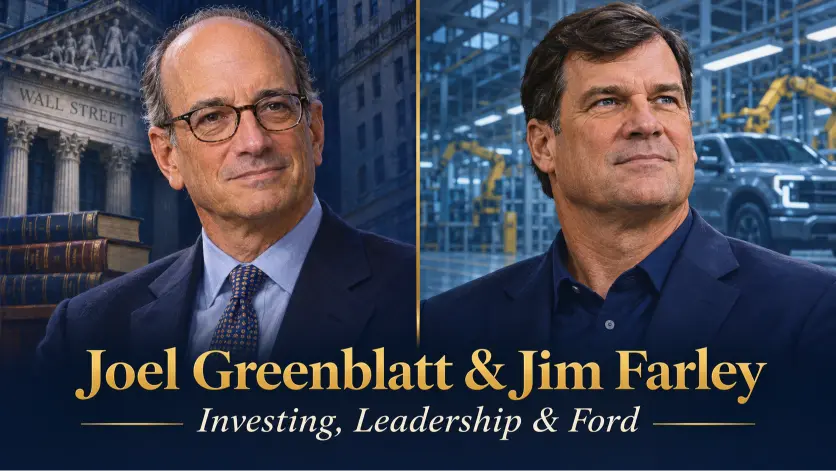
Joel Greenblatt and Jim Farley approach business from different directions. Greenblatt is known for investment management, financial writing and teaching. Farley leads Ford Motor Company, where business decisions involve vehicles, manufacturing, employees, customers and technology. One evaluates businesses as investment opportunities; the other is responsible for running a major automotive company.
Seeing their names together naturally raises a question: is there a connection between them? The answer requires a distinction. Public records reviewed for this article do not establish a personal partnership or joint venture. However, a regulatory filing does document Ford shares in a fund for which Gotham Asset Management, Greenblatt’s firm, serves as investment sub-adviser.
That is an institutional investment connection, not evidence that the two men work together personally. Understanding the difference helps explain both their individual careers and what their names mean in a business comparison.
Who Is Joel Greenblatt?
Joel Greenblatt is an investor, author and educator associated with value investing. According to Gotham Asset Management’s official biography, he founded Gotham Capital in 1985. Gotham Asset Management is its successor, and Greenblatt serves as a managing principal and co-chief investment officer.
His background combines professional investing with education. Gotham records his undergraduate degree and MBA from the Wharton School of the University of Pennsylvania. It also notes that he taught Value and Special Situation Investing on Columbia Business School’s adjunct faculty for more than two decades.
Greenblatt reached a broader audience through books including You Can Be a Stock Market Genius and The Little Book That Beats the Market. His writing helps explain why his name appears beyond discussions of professional fund management.
For readers encountering him for the first time, the central theme is straightforward: understanding a business and considering its price are separate tasks. A familiar company is not automatically an attractive investment, while an overlooked company is not automatically a bargain.
What Is Greenblatt’s Magic Formula?
Greenblatt’s best-known investing framework is commonly called the Magic Formula. Wiley’s description of his book explains that it combines two measures: earnings yield and return on capital. The objective is to identify businesses offering an appealing combination of operating performance and valuation.
Earnings Yield: Considering the Price
Earnings yield relates a measure of business earnings to a measure of its purchase valuation. In this framework, a higher yield can indicate that an investor is paying less for a given amount of operating earnings. It is a comparison tool, not a guarantee that those earnings will continue.
Return on Capital: Considering the Business
Return on capital examines operating earnings relative to the capital employed in the business. It helps distinguish a company that requires substantial resources to produce profits from one that generates profits using comparatively less capital.
The framework brings those questions together rather than selecting companies solely because their shares look inexpensive. Its name should not be taken literally: screening rules cannot eliminate business risk, uncertain forecasts or periods of disappointing performance.
Who Is Jim Farley?
Jim Farley is the president and chief executive officer of Ford Motor Company. Ford’s records place the beginning of his CEO tenure in October 2020, following earlier leadership positions within the company.
His career is rooted in the automotive industry. A Ford career fact sheet explains that he joined Ford in 2007 after working at Toyota and Lexus. Before becoming CEO, his Ford responsibilities included serving as chief operating officer and leading New Businesses, Technology and Strategy.
That experience places him on the operating side of business. A chief executive must translate plans into products, production decisions and customer experiences. Financial targets matter, but reaching them depends on execution across an organization.

How Farley’s Responsibilities Differ From Greenblatt’s
A portfolio manager can compare opportunities across many businesses. A chief executive has a different responsibility: making decisions within the organization entrusted to them. Farley cannot respond to a difficult manufacturing problem simply by replacing Ford with another company in a portfolio.
For an automotive executive, a decision about a vehicle program reaches into engineering, purchasing, factories, distribution and customer support. Spending takes place before the full commercial outcome is known. Changing direction can involve real costs and operational disruption.
An investor usually has more flexibility about which businesses to own. That flexibility brings its own challenge: selecting among competing opportunities while managing uncertainty and avoiding excessive confidence in a valuation.
Neither role is simply easier. They demand different forms of judgment. Evaluating an organization from outside and improving it from inside are related activities, but they are not interchangeable.
What Is Ford’s Strategy Under Farley?
Ford describes Farley’s strategic agenda through its Ford+ plan. The company’s leadership biography connects that plan with vehicles, established brands, software and services.
The same biography explains Ford’s organization around three automotive businesses: Ford Blue, associated with gasoline and hybrid vehicles; Ford Model e, associated with electric vehicles and digital development; and Ford Pro, focused on commercial customers and related services.
These categories help a reader understand why evaluating an automaker involves more than counting vehicle sales. Different products and customer groups can have different economics, development needs and competitive pressures.
Ford’s stated ambitions should also be distinguished from achieved results. A strategy describes what management intends to accomplish. Financial reports, product quality and customer outcomes provide evidence of whether execution is moving in that direction.
Is There a Documented Connection Between Them?
There is a specific financial record worth noting. In an SEC-filed report covering March 31, 2026, the Gotham 1000 Value ETF listed 81,887 Ford Motor Company shares, valued at $944,976. The report identifies Gotham Asset Management as investment sub-adviser to the funds covered.
This establishes a dated fund holding. It does not establish Greenblatt’s personal ownership, a meeting with Farley or a jointly managed business. Nor should a March portfolio snapshot be presented as proof of the position held today.
The distinction is useful because headlines often compress institutional activity into an individual’s name. Saying that a Gotham-advised fund reported Ford shares is more precise than suggesting Greenblatt personally entered a partnership with Ford’s CEO.
The reviewed sources did not establish a direct personal partnership between Joel Greenblatt and Jim Farley. Their professional worlds can intersect through capital markets without requiring a personal relationship.
Joel Greenblatt and Jim Farley Compared
| Area | Joel Greenblatt | Jim Farley |
|---|---|---|
| Primary role | Investment manager, author and educator | Automotive chief executive |
| Organization | Gotham Asset Management | Ford Motor Company |
| Typical decision | Evaluating and selecting investments | Directing business operations and strategy |
| Publicly associated framework | Magic Formula investing | Ford+ strategy |
| Central challenge | Assessing value under uncertainty | Turning strategy into operating results |
Where Investing and Business Leadership Meet
Capital allocation is the clearest conceptual link between these careers. The term means deciding where money and resources should go. Investors allocate capital among opportunities; executives allocate it within their businesses.
Consider a hypothetical manufacturer choosing between expanding an existing factory and developing a new product. Management must estimate costs, likely demand and the resources each option requires. An outside investor then assesses whether those choices make the company’s valuation attractive.
The same business can therefore produce two different questions. Management asks whether a project should be undertaken. The investor asks whether owning the company at the available price makes sense. Agreement about the quality of a product does not necessarily produce agreement about the stock.
This example illustrates the distinction between the roles. It does not represent a documented discussion between Greenblatt and Farley or a claim about Greenblatt’s current view of Ford.
Why a Good Business and a Good Investment Differ
A useful lesson from comparing an investor with an executive is that business quality and investment attractiveness are not identical. A company can have loyal customers, capable employees and successful products while its shares reflect highly optimistic expectations.
Conversely, a company facing difficulties may trade at a low valuation. That low price could represent an opportunity, or it could reflect problems that will persist. The price alone cannot settle the question.
Management performance also needs context. An executive may improve an operation while broader economic conditions weaken demand. An investor may correctly identify a business improvement but pay too much for the resulting earnings.
These distinctions explain why biographies cannot substitute for company analysis. Admiring an investor or executive does not establish whether a particular security is suitable or attractively priced.
What Readers Should Avoid Assuming
The combined keyword can encourage several shortcuts. The first is treating a reported fund investment as a personal endorsement. Portfolio positions can reflect a team process, a systematic strategy or decisions made for a particular mandate.
The second is confusing a holding with a partnership. Share ownership and a jointly operated venture are different arrangements. Evidence for one does not establish the other.
The third is removing dates. A career appointment, financial result or investment position belongs to a particular period. Omitting that period can turn a historical fact into a misleading statement about the present.
- Use company biographies to verify professional roles.
- Use the relevant filing to establish a reported holding.
- Keep fund assets separate from personal wealth.
- Distinguish an author’s comparison from documented collaboration.
How to Read Their Public Records
Start with the question you actually want answered. For Greenblatt’s career, Gotham’s biography and his publishers provide useful background. For Farley’s responsibilities, Ford’s leadership materials offer the most direct starting point.
For a financial connection, move beyond biographies. The report discussed above specifies a fund, a reporting date, a security and a position. Those details make the statement testable and prevent a broad headline from replacing the underlying record.
For a claimed personal collaboration, look for different evidence: an announcement, an attributable interview or reliable reporting naming the project. A search result containing both names is only a starting point.
Frequently Asked Questions
Are Joel Greenblatt and Jim Farley Business Partners?
The reviewed sources do not establish a direct business partnership. A fund associated with Gotham reported Ford shares, but that is different from a partnership between Greenblatt and Farley.
Does Joel Greenblatt Personally Own Ford Stock?
The cited fund report does not answer that question. It documents securities held by the fund, not Greenblatt’s personal investment account. Those forms of ownership should not be conflated.
What Is Joel Greenblatt Best Known For?
He is widely associated with value investing, Gotham, financial education and the Magic Formula framework explained in his investing books.
When Did Jim Farley Become Ford CEO?
Farley became Ford’s chief executive in October 2020 after holding earlier leadership roles at the company.
Does Gotham’s Ford Holding Mean Ford Is a Good Investment?
No such conclusion follows from the holding alone. A dated position does not disclose every investment consideration or establish that the same security is appropriate for another investor.
Understanding the Comparison
Joel Greenblatt and Jim Farley offer two perspectives on how businesses use capital. Greenblatt’s work concerns evaluating investment opportunities, while Farley’s responsibilities concern leading an organization and delivering operating results.
The documented fund holding gives the comparison a concrete financial reference. It should remain exactly that: evidence of an institutional position at a stated date. Their careers can be compared meaningfully without inventing a personal alliance or treating a portfolio disclosure as something it is not.